
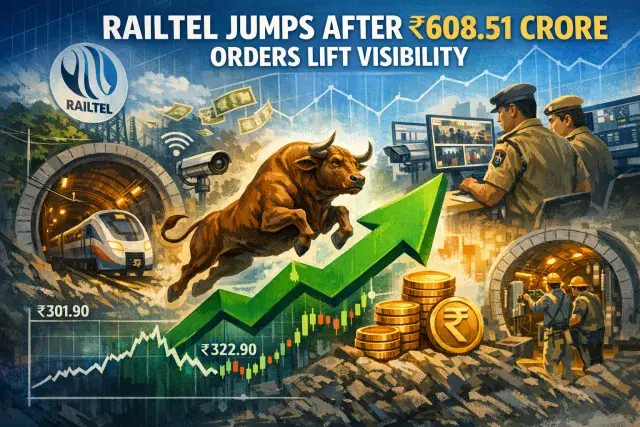

RailTel shares rose sharply on Wednesday, April 15, after the state-run telecom and digital infrastructure company disclosed three new orders worth ₹608.51 crore. The move matters because large public-sector contracts can quickly improve revenue visibility for companies such as RailTel, even when recent profit growth has been uneven.
The stock opened at ₹301.90 on the BSE, climbed to an intraday high of ₹322.90, and touched a low of ₹301.85. The rally followed confirmation that RailTel had secured two Letters of Acceptance from RVNL worth a combined ₹564.54 crore for integrated tunnel communication systems, alongside a ₹43.96 crore work order from the Uttar Pradesh Police Recruitment and Promotion Board for security-related ancillary services during recruitment examinations.
Why the new orders matter
The largest portion of the fresh business comes from tunnel communication systems, a specialized area tied to transport safety and operational continuity. Such systems are central to maintaining communications, monitoring, and coordination in rail tunnels, where conventional network coverage can be limited and failures can create outsized operational risk. For RailTel, this fits squarely within its original mandate of building telecom and multimedia networks that support Indian Railways’ control and safety functions.
The Uttar Pradesh Police Recruitment and Promotion Board order is smaller, but it points to another side of RailTel’s business model: public digital infrastructure and service support beyond core railway operations. Recruitment examinations in India increasingly depend on secure communications, surveillance support, and coordinated digital systems, making this type of contract relevant to the broader state technology ecosystem.
A strong order book, despite one reversal
Both newly announced projects are scheduled for completion by April 12, 2028, giving RailTel a multi-year execution pipeline. Long-duration public contracts can provide stability, but they also place pressure on delivery, cost control, and project management. Investors often reward order wins immediately, yet the longer-term test is execution quality and the conversion of orders into revenue and margin.
That is also why the withdrawn Navodaya Vidyalaya Samiti work order, valued at ₹17.12 crore, deserves attention even if it is modest beside the new wins. The cancellation was attributed to unavoidable administrative reasons, a reminder that government-linked business can be sizable and repeatable, but it is also exposed to procedural changes, approvals, and institutional delays.
How this fits RailTel’s recent financial picture
The company’s latest reported numbers showed a mixed trend. Standalone net profit fell 4.07% year on year to ₹62.40 crore in Q3 FY26, while revenue from operations rose 18.99% to ₹913.45 crore. That combination suggests business expansion is continuing, but profit conversion has not kept pace. In that context, fresh orders help reinforce confidence in demand, though they do not by themselves resolve questions around margins.
RailTel had already disclosed another contract last month: a ₹42.63 crore order, inclusive of tax, from NICSI for the New Core Link project under the National Knowledge Network, to be completed by March 31, 2027. Together, these announcements show a company deepening its role in public-sector communications infrastructure, from railway systems to institutional network projects.
What the market is signaling now
According to Rajesh Bhosale, Equity Technical and Derivative Analyst at Angel One, the stock’s sharp gap-up opening and strong volumes indicate a possible change in trend. He said the share price has moved above its 89-day EMA for the first time in three months, with the ₹345 to ₹350 zone emerging as the next resistance area, while the gap region around ₹300 may act as near-term support.
For investors, the immediate enthusiasm reflects more than a single-day price move. It reflects the market’s preference for companies tied to public digital infrastructure, transport modernization, and security-linked communications. RailTel sits at the intersection of those themes. The next phase will depend less on the headline value of new contracts and more on whether the company can turn a growing order flow into stronger and more consistent earnings.
