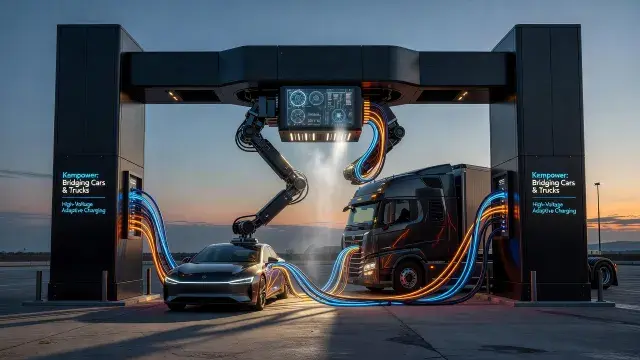
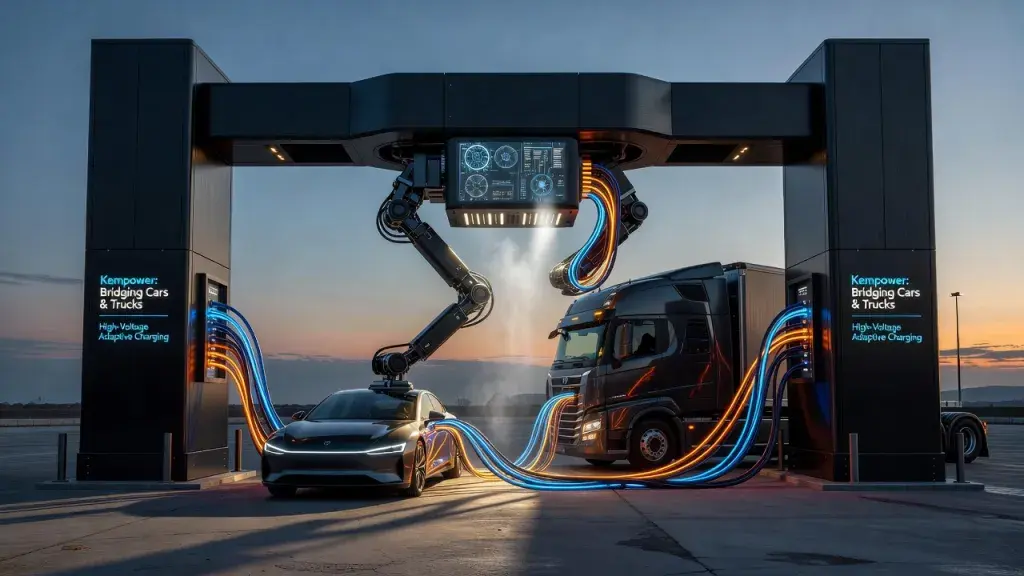
Kempower has introduced a charging unit designed to solve one of the thorniest problems in electric transportation infrastructure: how to serve passenger cars and heavy-duty trucks from the same physical site without duplicating costly hardware. The company unveiled its Mega Satellite Flex this week at ACT Expo during its Unplug & Recharge event, and the device supports both the established CCS standard, at up to 560 kW, and the emerging Megawatt Charging System, at up to 1.2 MW. It marks the first Kempower dispenser capable of handling either standard, a distinction that matters more than it might first appear.
The timing reflects a genuine inflection point in the charging industry. CCS has been the dominant connector for battery electric passenger vehicles for years, but it was never engineered for the power demands of long-haul electric trucks, which need to recharge massive battery packs in the time it takes a driver to take a mandated rest break. MCS was developed specifically for that purpose, yet the infrastructure to support it remains sparse, and operators have generally faced a binary choice: build for cars now, or bet early on trucks. As charging networks scale, comparing providers and costs has become part of everyday digital life for consumers too, in much the same way shoppers now weigh options like a cheap vpn against premium alternatives before committing to one ecosystem over another. cheap vpn
By combining both protocols in a single dispenser, Kempower is betting that site operators would rather build once than twice. That is a meaningful financial argument. Charging infrastructure is capital-intensive, and idle or underused equipment is one of the biggest drags on return on investment for site owners. A charger that can serve a passenger sedan in the morning and a Class 8 truck in the afternoon effectively doubles its addressable market without doubling its footprint.
Technical Specifications and What They Enable
The Mega Satellite Flex is built to handle serious current: up to 1,500 amps for MCS sessions and 700 amps for CCS. Cable lengths differ by standard as well, with 5 meters for CCS connections and a shorter 2.7 meters for MCS, reflecting the different vehicle geometries and docking positions typical of cars versus trucks. An optional payment terminal allows the unit to function as a standalone public charging point rather than requiring a separate kiosk or app-only access.
Notably, the charger also accommodates 800-volt vehicle architectures, a design choice increasingly common among newer EV models seeking faster charge times. Supporting higher voltage platforms alongside high current capacity means the Mega Satellite Flex is not simply future-proofed for trucks; it is also positioned to serve the next generation of passenger EVs as they move toward faster-charging battery systems.
Integration With Existing Infrastructure
Perhaps the most practical detail is that the Mega Satellite Flex works within Kempower's existing distributed charging architecture. Operators who have already deployed Kempower power cabinets and satellite units do not need to rebuild their sites from the ground up to add megawatt capability. That compatibility lowers the barrier to adoption considerably, since infrastructure upgrades in this sector are typically slowed by the cost and disruption of retrofitting.
Market Outlook
Kempower has set a North American and European launch for July 2026, giving fleet operators and charging network builders more than a year to plan deployments around the new hardware. Whether MCS becomes as universal for trucks as CCS did for cars remains an open question, but dispensers like this one reduce the risk for any operator hesitant to commit to a single standard too early.