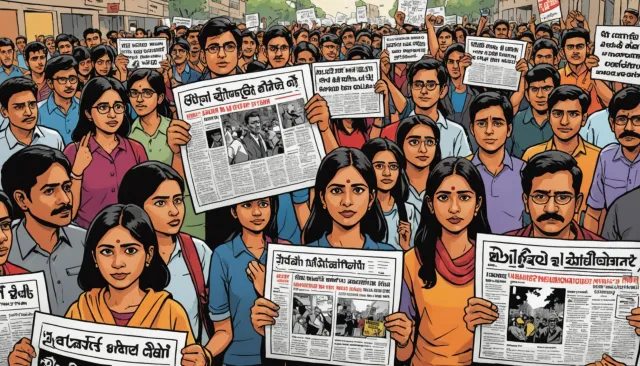
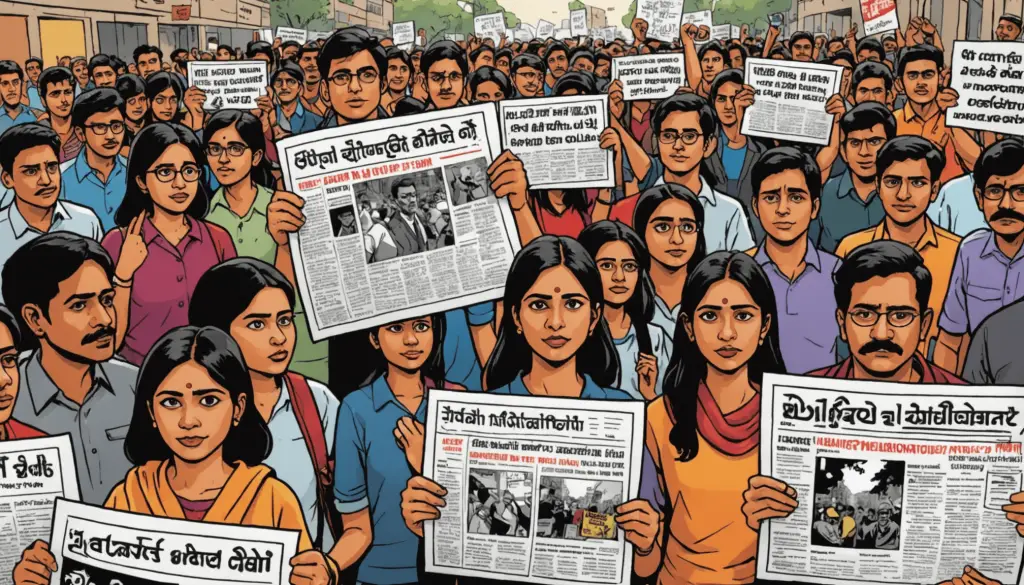
Photos and videos documenting student protests in Delhi were quietly restricted on Instagram this week, with users and digital rights advocates reporting that content was being labelled "sensitive" or simply disappearing from feeds - without explanation from Meta. The complaints emerged as clashes between protesters and police intensified at the demonstration site, where tear gas and lathicharges were used to disperse crowds gathered over alleged irregularities in the NEET-UG examination.
What users are reporting
Multiple accounts, including those linked to Cockroach Janta Party (CJP) and politician Anish Gawande, found their posts tagged as "sensitive content" despite containing footage that appeared to be standard television broadcast clips. Users told ET that their discovery pages had stopped surfacing protest-related material altogether, even for people who had been actively engaging with such content for weeks. In several cases, clicking "know more" on flagged posts still failed to reveal the underlying video or image, leaving users unable to view what had been restricted or why. buy vpn
Apar Gupta, founder of the Internet Freedom Foundation, described this as a partial and unsatisfying form of transparency. A label appears, signalling that some restriction has been applied, but the platform does not disclose which specific standard the content supposedly violated. IFF has formally asked Meta whether these actions were prompted by legal requests from Indian government authorities - a question that remains unanswered.
The account suspension
The pattern escalated on Wednesday evening when CJP's official Instagram account, followed by 25 million people, went dark in India. Meta's message on the handle stated that the account was "not available in India" because the company had "complied with a legal request to restrict this content." Earlier the same day, a separate account belonging to CJP spokesperson Saurav Das had been suspended and then restored, after Meta acknowledged its automated moderation systems had flagged it in error.
The juxtaposition of an admitted algorithmic mistake and a separate, deliberate legal-compliance action illustrates the difficulty of untangling why any given piece of content disappears. Platforms operate layered systems - automated classifiers, human review teams, and legal compliance units - that can each independently restrict material for entirely different reasons, often without disclosing which one was responsible.
Where the law stands
Legal and cybersecurity experts note that platforms do retain some discretion to moderate content during unrest, particularly material that could incite violence. But that discretion is not unlimited. Restricting speech without providing reasoning risks running against Article 19(1)(a) of the Constitution, which guarantees freedom of speech and expression, and against principles of proportionality that courts have applied to online takedowns in the past.
Industry observers point to a broader pattern: content documenting rights violations or state action against protesters - the kind of material human rights bodies and the United Nations have historically relied on as documentary evidence - has repeatedly been restricted on major platforms, often through opaque processes. Instagram itself states it does not rely on a single algorithm but a mix of classifiers and processes, each governing different parts of the experience, which makes it harder for outside observers to know which system triggered a given restriction, and harder still to challenge it.
For now, Meta has not responded to queries about whether government demands are driving the restrictions. That silence, more than the restrictions themselves, is what advocates say undermines public trust in how platforms police speech during politically sensitive moments.