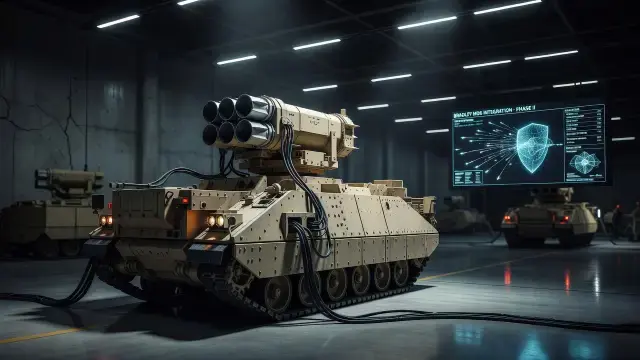
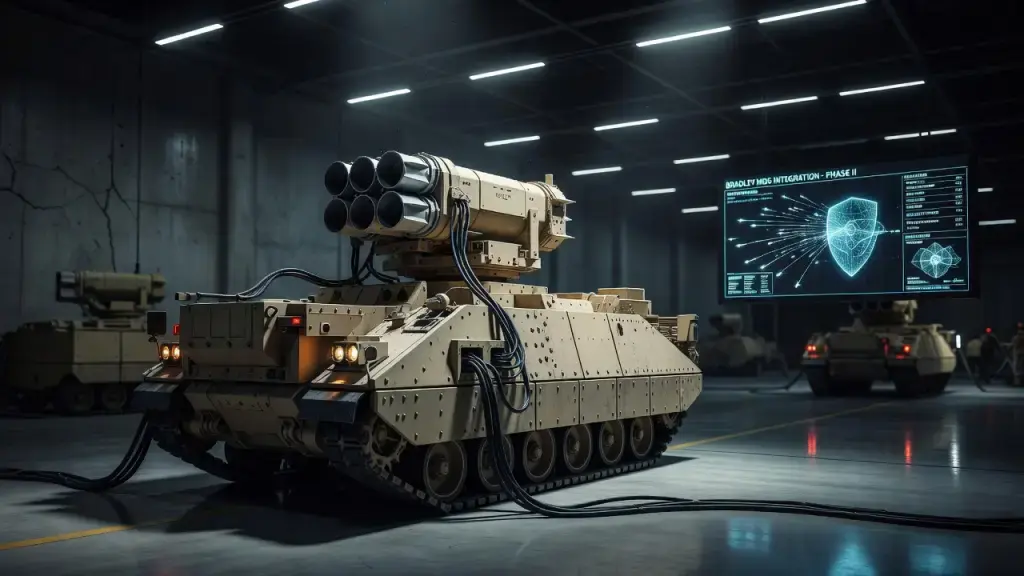
The U.S. Army has started putting a new layer of protection on its front-line armored vehicles, deploying Bradley Fighting Vehicles equipped with an active defense system built to shoot down incoming missiles, rockets and drones before they hit. The 1st Cavalry Division's 6th Squadron, 9th Cavalry Regiment, at Fort Hood, Texas, is the first unit receiving the upgraded M2A4E1 Bradley, which integrates Elbit Systems' Iron Fist system under a $228 million contract awarded in January.
The move reflects a broader reassessment of how vulnerable armored vehicles have become on modern battlefields. Just as internet users facing restrictive networks must learn what to do when a country blocks VPN traffic and adapt their defenses accordingly, militaries are now forced to treat vehicle protection as a dynamic, layered problem rather than a fixed design feature. Armor alone no longer guarantees survivability against cheap, precise anti-tank weapons and loitering drones, a lesson driven home repeatedly in Ukraine, where even heavily protected vehicles have proven vulnerable to shoulder-fired missiles and small aerial threats.
How Iron Fist Works
Iron Fist belongs to a category of defenses known as active protection systems, distinct from passive armor that simply absorbs impact. Radar and infrared sensors mounted around the Bradley's turret continuously scan for approaching threats, calculating trajectory and timing with enough precision to launch a countermeasure. When a missile, rocket-propelled grenade or drone is detected, the system fires an explosive interceptor designed to destroy the threat before it reaches the vehicle's hull. Engineers built the interceptor's casing to combust rather than fragment, reducing - though not eliminating - the danger to infantry operating nearby.
This approach marks a shift from decades of thinking that prioritized thicker armor and better shaping to deflect blasts. Active interception instead treats incoming fire the way missile defense systems treat ballistic threats: detect early, calculate a response, and neutralize the object before contact. The tradeoff is complexity. Sensors, radar processing and interceptor logistics add weight, cost and maintenance burden to vehicles already strained by years of incremental upgrades.
A Contract With Open Questions
Elbit's role in this program is narrower than it might first appear. The Israeli firm is not the prime contractor for the Bradley upgrade effort, which General Dynamics leads; Elbit supplies the protection system itself, with revenue recognized as units are delivered and integrated into vehicles. The $228 million award follows a smaller $37 million order placed in 2024, suggesting a steady scaling of production rather than a single large rollout.
What remains unclear is the scope of the broader deployment. The Army has not disclosed how many Bradleys will ultimately receive Iron Fist, nor a timeline for expanding the system beyond the initial Fort Hood unit. That ambiguity is not unusual for defense procurement, where contracts often establish a framework for future orders rather than a fixed delivery schedule. It does mean, however, that the pace at which Iron Fist reaches the wider Bradley fleet will depend on budget decisions and operational assessments still to come.
Why It Matters Beyond One Vehicle
The M2A4E1 upgrade bundles Iron Fist with other improvements, including a higher-resolution thermal sight for gunners and a new environmental control unit for crew and passengers. Together, these changes signal an Army trying to extend the service life of a vehicle platform that first entered use decades ago, rather than replace it outright. Active protection systems like Iron Fist are increasingly viewed as a necessary layer of defense, not an optional add-on, as the proliferation of precision-guided weapons and inexpensive drones changes the calculus for any force operating armored vehicles in contested environments.